

 ไทย
ไทย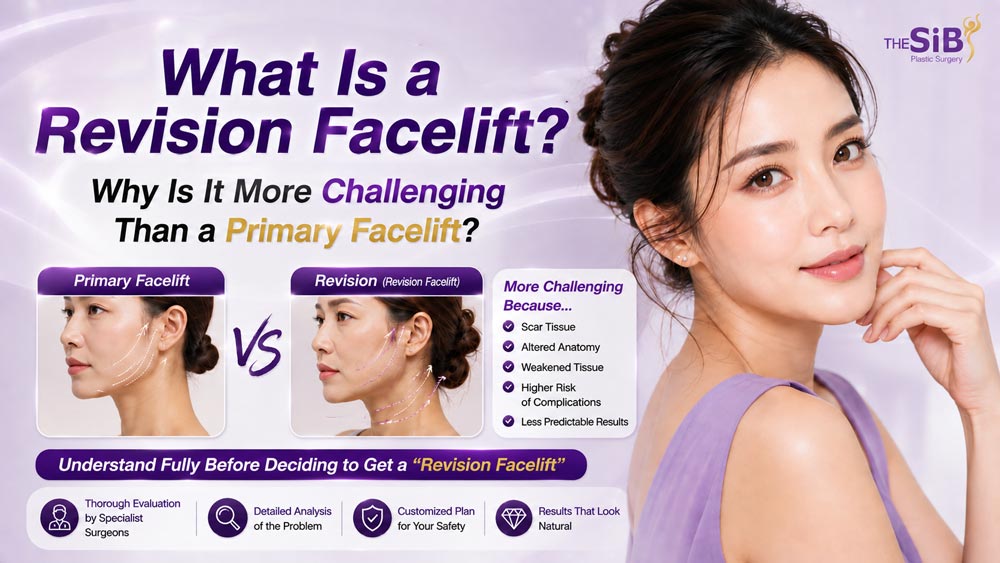
A Revision Facelift is a surgical procedure designed to correct undesirable results, deformities, or returning sagging that occurs after an initial facelift. It is many times more difficult and complex than a primary surgery because the surgeon must deal with scar tissue (fibrosis) from the old wounds, altered anatomical structures, and decreased skin elasticity. Revision surgery requires a highly specialized plastic surgeon with immense expertise in dissecting scar tissue and reorganizing the muscle layer (SMAS) to repair the face, restoring a beautifully soft, natural appearance while hiding scars as safely as possible.
Key Takeaways
- Who it’s for: Individuals who have had a previous facelift but experienced unnatural results, large scars, ear deformities (Pixie Ear), or unusually rapid returning sagging.
- Pros and limitations: It helps regain confidence and corrects past mistakes, but it requires more time in the operating room, has high complexity, and generally costs more than a primary procedure.
- Recovery time: Swelling and bruising might be slightly more pronounced than in a normal case due to the dissection of scar tissue. The primary recovery period takes about 10–14 days.
- Result longevity: If corrected by properly restructuring the deep muscle layers, the youthful results can last a long 5–10 years.
- What to know before deciding: Do not rush into a revision. You should wait at least 6-12 months after the initial facelift to allow tissues and scars to heal completely before undergoing a new surgery.

| Comparison Criteria | Primary Facelift | Revision Facelift |
|---|---|---|
| Internal Tissue Condition | Intact original structure, no scar tissue | Thick scar tissue, altered anatomy |
| Surgery Duration | 3 – 5 hours | 5 – 7 hours (long time spent dissecting scar tissue) |
| Nerve Risk | Low (locations are clearly identifiable) | Higher (requires specialized expertise) |
| Available Skin for Trimming | Elastic skin with plenty to trim | Skin may be scarce (Skin Shortage) |
| Recovery Time | 7 – 10 days | 10 – 14 days (swelling/bruising may last slightly longer) |
| Primary Goal | Rejuvenation, reducing sagging | Structural repair, restoring a natural look |
What is a Revision Facelift?
A revision facelift is an advanced plastic surgery procedure aimed at correcting problems or undesirable results from a previous facelift. Whether it is premature returning sagging, ugly scars, or a facial shape that looks unnatural, the surgeon must open the old incisions to access the structure, dissect the scar tissue, and completely reorganize the tissues.
Top Reasons Patients Need a Revision Facelift
- Unnatural Appearance: The face looks stiff, unnaturally tight, the smile is restricted, or it looks like it is constantly being blown by a strong wind (Windblown look). This often results from pulling only the skin layer.
- Pixie Ear Deformity: The earlobes are stretched and pulled down into a sharp point attached to the cheek. This is caused by suturing the skin too tightly, transferring the tension to the earlobes.
- Noticeable Scars or Keloids: Scars in front of the ear or hairline become widened, thick, raised, or discolored, requiring constant concealment with hair.
- Early Relapse: A facelift done only 1-2 years ago, but the face has already dropped and sagged again. This usually happens because the deep muscle layer was not sutured tightly enough.
Why is a Revision Facelift Many Times “Harder” Than the First?
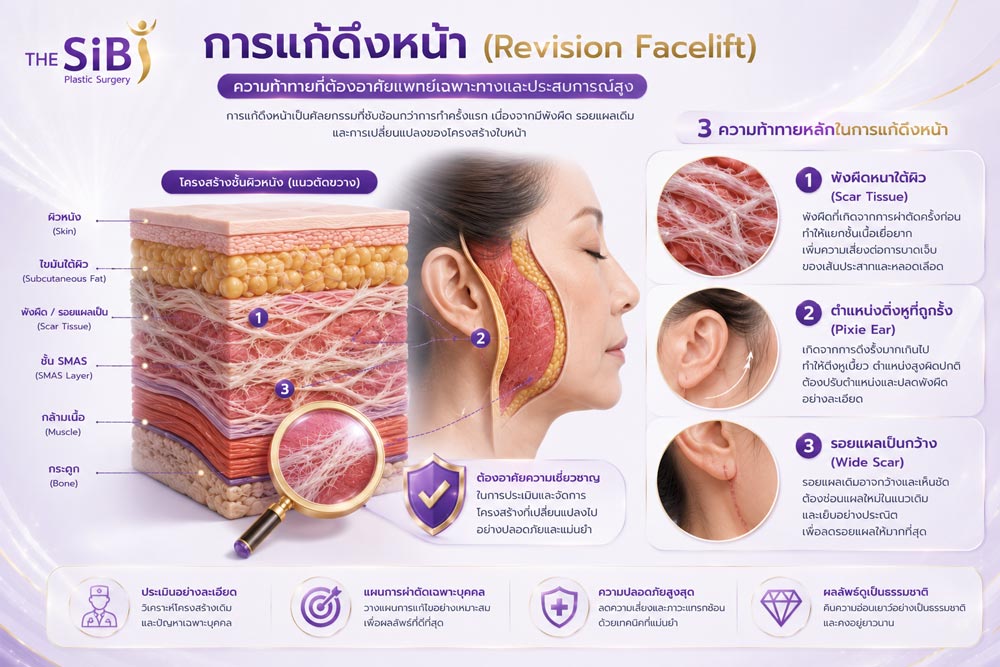
The main difficulty in revision surgery lies in the “scar tissue (fibrosis)” and the “altered anatomy.” The doctor cannot predict the locations of nerves and blood vessels as they would in a primary case because the first surgery disturbed the original anatomy. The surgery is essentially navigating through an area full of obstacles.
Challenges Surgeons Face in Revision Cases
- Hard and Sticky Fibrosis: The initial surgery causes the body to create scar tissue to heal wounds beneath the skin. These bands are sticky and firmly attached, making it difficult to separate the skin from the muscles. It requires significant time and precision.
- Altered Nerve Locations: Nerves controlling facial expressions might be stretched or shifted from their original positions. The surgeon must possess advanced anatomical expertise to avoid hitting these nerves.
- Skin Shortage: In cases where the previous doctor excised too much skin, pulling it again or hiding new incisions becomes much harder because there isn’t enough excess skin to comfortably close the wound.
- Compromised Blood Supply: Previously operated tissues have fewer capillary blood vessels feeding them. Revision surgery must be mindful of skin ischemia (lack of blood supply), which can slow healing.
Techniques to Restore a Beautiful, Soft, and Natural Face
A lasting revision will not just pull the skin again. The doctor focuses on patiently releasing the scar tissue and then repositioning the SMAS muscle fascia layer so that the deep core takes the tension instead of the skin. This restores softness to the face and results in smoother new scars.
Standard Revision Facelift Steps at The SiB Clinic
- Meticulous Dissection: The surgeon slowly and extremely carefully separates the skin layer from old scar tissue, preserving as many of the original nerves and blood vessels as possible.
- Pixie Ear Correction: The doctor relieves the tension pulling on the earlobe, reshapes it to a natural curve, and transfers all lifting tension to the internal muscles.
- SMAS Repositioning: The surgeon sutures and repositions the SMAS muscle layer to ensure it is strong and correctly aligned, lifting the facial structure without relying on tension from the skin.
- Tension-Free Closure: Once the internal structure is secure, the outer skin is draped and closed using ultra-fine sutures with zero tension. This ensures the new scar is smooth, doesn’t widen, and prevents recurrent keloids.
Checklist: What Problems Demand a “Revision Facelift”?
If you look in the mirror and notice that your face appears highly unnatural, your facial expressions look rigid, or you have tension-pulling scars that destroy your confidence, these are signs that you may need an assessment to reconstruct your facial framework.
Checklist: Symptoms Requiring Plastic Surgeon Consultation for Revision
- ✔️ Earlobes appear long, pointed, and attached to the cheek, or the crease in front of the ear looks deformed.
- ✔️ Large, thick, raised, or discolored scars exist around the front of the ear and hairline.
- ✔️ The face looks flat, lacks dimension, and appears as if pulled back tightly (Windblown Look).
- ✔️ You feel a constant, tight pulling sensation around the cheeks and mouth corners, even years later.
- ✔️ The jawline droops again, and nasolabial folds return deeply just 1-2 years after the procedure.
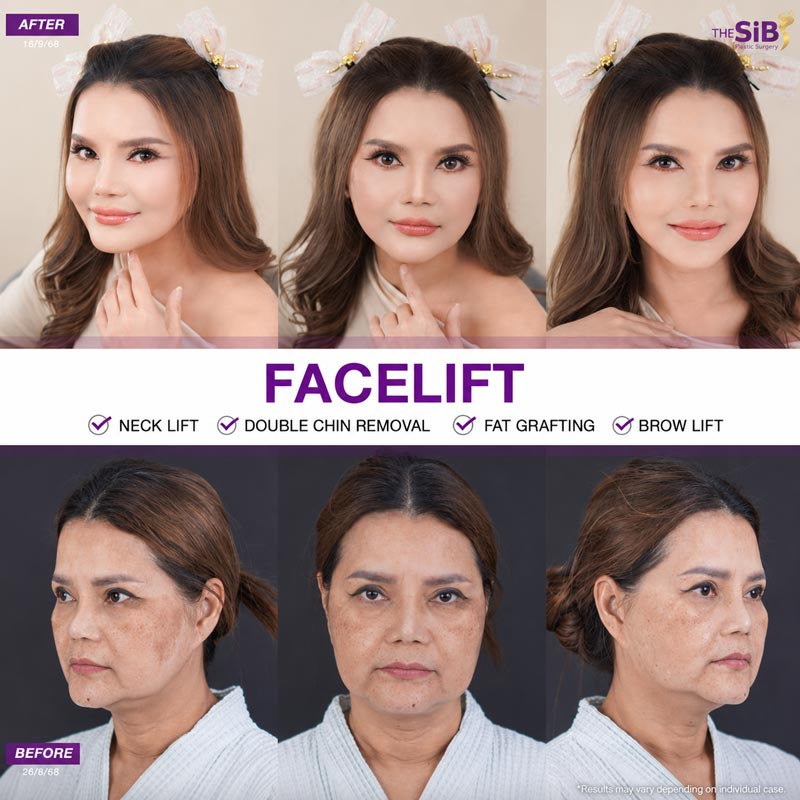
Why Should You Trust Dr. Darin Muangthai at The SiB Clinic for a Revision Case?
A revision case is one where there is “no room for another mistake.” Entrusting it to a highly experienced specialized plastic surgeon like Dr. Darin Muangthai is the safest choice because it requires both the skill to repair structures and the artistry to conceal scars, perfectly restoring your confidence.
- A True Board-Certified Plastic Surgeon: Dr. Darin deeply understands facial anatomy and scar tissue mechanics, allowing her to accurately manage the complexities of revision cases.
- Honest and Straightforward Assessments: The doctor meticulously analyzes your skin and tissue condition. If it is not yet time to revise, she will advise you to wait to ensure the safest results.
- Keloid Correcting Hidden Scar Technique: Expert in the Tension-Free technique, which helps correct ugly old scars, making them smaller, smoother, and blending them flawlessly with the ear creases.
- Hospital Grade Safety: Complex surgeries take longer, so they must be performed in international standard sterile operating rooms, supervised by a specialized anesthesiologist throughout the general anesthesia process.
Conclusion & Recommendations
Revision facelift work is immeasurably more challenging and complex than a primary facelift. However, with current medical techniques and care from a skilled, specialized surgeon, problems like stiff faces, wide scars, or deformed earlobes can definitely be repaired to achieve a beautiful, soft, and natural result. Investing in this revision will restore your image and long-term confidence (High ROI).
Our Recommendation for You: If you are anxious about your past facelift results, we recommend bringing your pre-primary surgery photos (if available) and current photos for a consultation with Dr. Darin Muangthai at The SiB Clinic. She will evaluate your scar tissue condition and assess the feasibility of a revision surgery to plan the safest treatment possible.
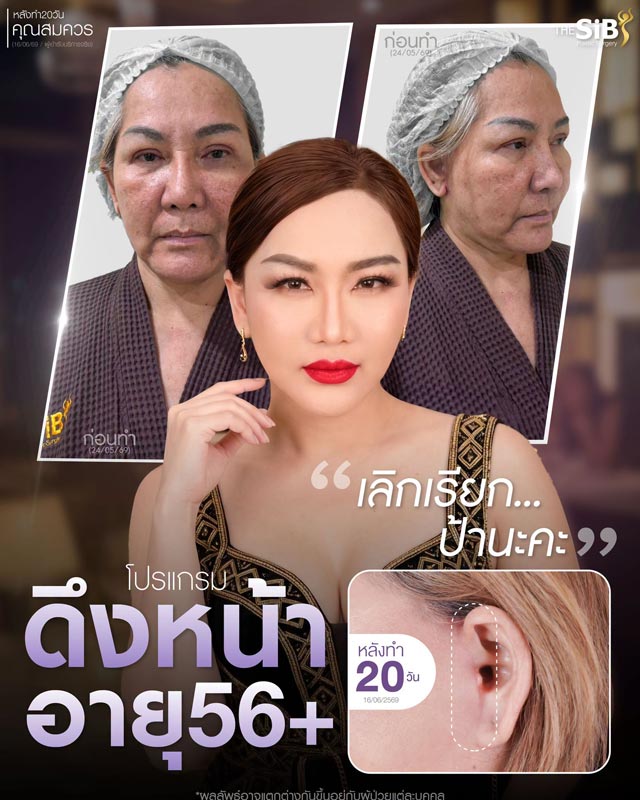
Frequently Asked Questions (FAQ)
If I’m unhappy with my first facelift, can I get it revised immediately?
It is not recommended to revise immediately. You should wait at least 6-12 months for the internal tissues and scar tissues to heal and inflammation to subside before a plastic surgeon can safely assess and perform a new surgery.
Is a revision facelift more painful than the first time?
During the surgery, you will not feel any pain because it is performed under general anesthesia. However, post-surgery, you may experience a deep pulling sensation and swelling/bruising for slightly longer than a normal case due to the dissection of scar tissue.
Can a Pixie Ear deformity be repaired to 100% normal?
It can be corrected and restored to a natural, rounded curve that is very close to 100% normal. The doctor will relieve the tension on the skin and reshape the earlobe.
Can the doctor simply cut away a large, old keloid scar?
The doctor will excise the old scar tissue when making the new incision. Tension-free suturing techniques will then be used to minimize the chance of the keloid returning.
Is the price of a revision facelift much more expensive than a normal case?
It is usually more expensive than a normal case because it requires more time in the operating room, has high complexity, and demands an advanced level of expertise to manage scar tissue.
My face has been stiff for 3 years; can it still be surgically corrected?
It can be corrected. The plastic surgeon will access and dissect the old scar tissue pulling on the face and reposition the SMAS muscle in a more natural direction.
How many recovery days are needed for a revision facelift case?
We recommend allocating about 10-14 days for recovery and taking leave from work. The swelling and bruising will gradually subside, and stitches can be removed as scheduled by the doctor.
If the previous doctor trimmed away a lot of skin, can a revision still be done?
This is a major challenge (Skin Shortage). The doctor must carefully evaluate the elasticity of the remaining skin. It may require a technique that tightens only the inner muscles with minimal to no skin pulling.
Will the results of a revision facelift last as long as a primary one?
If the doctor can successfully access and firmly restructure the deep muscle layer (SMAS), the results can lock in youthfulness for a long 5-10 years, just like a new procedure.
Is general anesthesia dangerous in revision cases that take a long time?
At The SiB Clinic, the safety is extremely high because we have a specialized anesthesiologist monitoring vital signs 1:1 throughout the entire surgery, regardless of how long it takes.


Considering cosmetic surgery in Thailand at The SiB Plastic Surgery?
Inquire or schedule a free consultation with our doctor.
 Whatsapp
  หน้าแรก
  โปรโมชั่น
  สอบถาม
  จองคิวฟรี