

 ไทย
ไทย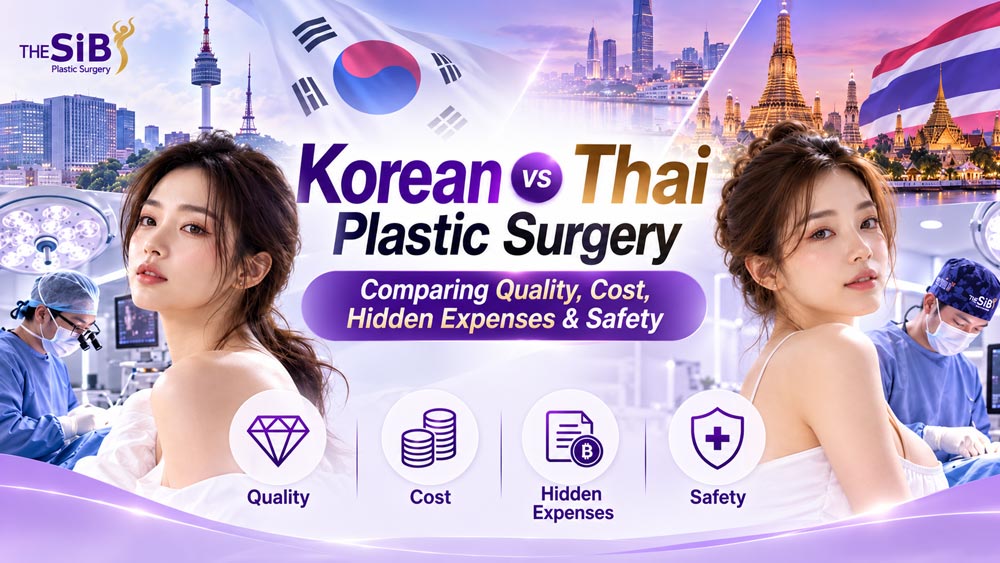
“Flying to get plastic surgery in Korea, or having it done in Thailand?” This is a classic question that Thai clients have weighed most heavily over the past decade. Especially entering 2027, where medical knowledge, technology, and information access are seamlessly connected globally. Many people often fall into the old stereotype trap that “Korean surgery yields softer results” or “Thai surgery is more budget-friendly.” But in reality, evaluating the worth of plastic surgery isn’t measured merely by the price tag or a country’s popularity. It must be measured by anatomical precision, risk management, and long-term results.
Key Takeaways
- True Value: Medically, this isn’t just the “surgery cost.” You must calculate all hidden costs, such as travel, accommodation, post-operative care, and the risks involved if a revision case occurs.
- Anatomy: The physical structure and skin condition of Thai and Southeast Asian people have unique characteristics (e.g., nasal base, skin thickness, and sebaceous glands). This requires a doctor with direct understanding of these specific structures.
- Post-Op Travel Risks: Flying immediately after major surgery carries physiological risks, including cabin pressure issues, severe swelling/inflammation, and Deep Vein Thrombosis (blood clots).
- Long-Term Follow-up: Plastic surgery is a process with a recovery phase lasting 6 months to 1 year. The convenience of seeing your operating surgeon is a crucial factor for maximum safety.
Understanding the Real “Value” from a Plastic Surgery Perspective
A common misconception is making a “Direct Price Comparison,” menu-style. For example, comparing the price of an Open Rhinoplasty or Abdominoplasty (Tummy Tuck) between a clinic in Thailand and a hospital in South Korea.
Clinically, plastic surgery is a procedure that permanently alters the body’s structure. Therefore, true value must be calculated using the equation: Safety + Anatomical Precision + Continuous Care. Overlooking these factors and focusing solely on a country’s reputation can lead to hidden costs or incalculable complications later on.
Qualitative Comparison: Clinical Dimensions and Design Philosophy
When viewed through a surgeon’s lens, both Korean and Thai plastic surgery share internationally equivalent standards in academics and modern equipment usage. However, there are profound differences in concepts and anatomy:
1. Anatomical Familiarity
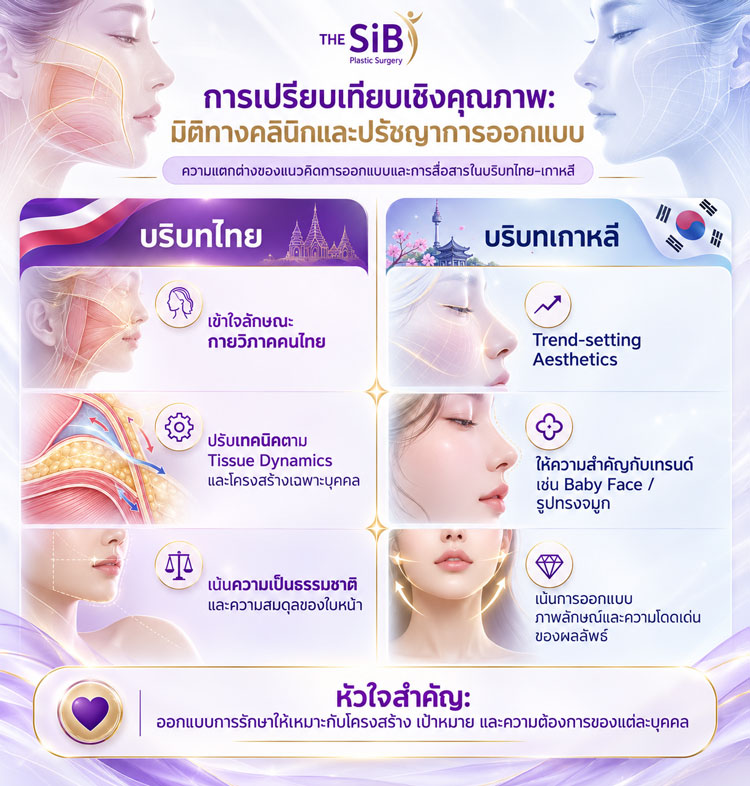
- Specific Anatomy of Thai/Southeast Asians: Often involves thicker skin, more subcutaneous sebaceous glands, weaker lower lateral cartilages in the nose, or facial bone structures distinct from East Asians.
- Personalized Technique Adjustments: Thai plastic surgeons who have accumulated experience with Thai cases are highly familiar with this specific Tissue Dynamics. They know exactly how much tissue can be stretched without risking extrusion or severe contracture, which differs from techniques designed for the thinner skin typically seen in Koreans.
2. Aesthetic Philosophy & Communication
- Korea: Often excels in “Trend-setting Aesthetics,” such as the Baby Face contour or a highly projected, slender nose shape. This appeals to those wanting to change their image according to popular trends.
- Thailand: Generally focuses on adjusting proportions to align with the face’s original unique features (Harmonized Balance) and strongly emphasizes the long-term safety of the original structure.
- Language Nuance: Plastic surgery requires communicating desires down to the millimeter. Communicating through an interpreter, even if linguistically correct, may result in losing the nuance of feelings, precise proportions, and the delicate concerns of the client.
Pricing Structure and Hidden Medical Costs: Korea vs. Thailand
To provide a comprehensive view for decision-making, the comparison table below highlights the multidimensional differences between getting surgery in Thailand versus traveling to South Korea:
| Evaluation Factors | Surgery in Thailand | Surgery in South Korea |
|---|---|---|
| Cost Structure | Pay only for the procedure, anesthesia, and prescribed medication | Procedure + Flights + Accommodation + Agency/Interpreter Fees |
| Monitoring Period | Can schedule follow-ups at 7 days, 1 month, 3 months, and 6 months | Usually only monitored during the stitch removal phase (first 7-14 days) before having to fly back. |
| Complication Management | Can see the operating surgeon immediately within 24 hrs. | Requires international travel, or finding a Thai doctor to provide temporary care. |
| Flight Risks | None | Risks related to cabin pressure and severe swelling/inflammation during the flight back. |
| Access to Revisions | Convenient, continuous medical records within the same system | Complex, overlapping travel costs, and potential limitations with consumer protection laws. |
Physiological Risks: Travel and Complication Management
Korea vs. Thailand: A crucial factor often overlooked when deciding to fly abroad for surgery is the physiological changes post-operation:
- ✈️ Cabin Pressure: After a major surgery, the body experiences inflammation and water retention (Edema). Flying while wounds are not fully healed exposes you to lower cabin pressure, which triggers tissue expansion. This increases the risk of subcutaneous bleeding (Hematoma) and severe pain.
- ✈️ Deep Vein Thrombosis (DVT): Sitting still for long periods on a plane after a surgery involving general anesthesia is a medical risk factor that increases the chance of blood clots breaking loose and lodging in the lungs.
- ✈️ Critical Healing Window: Surgical wounds require close assessment during the first 1-3 months. Infections, implant displacement, or incomplete healing often manifest *after* the patient has returned to their home country. This makes maintaining continuity of medical care very difficult.
Decision Framework: Which Option is Right for You?
Surgeons recommend using the following criteria to evaluate your situation:
Cases Best Suited for Surgery in Thailand:
- Procedures Requiring Long-Term Structural Strength: Such as Open Rib Rhinoplasty, Deep Plane Facelifts, or Tummy Tucks. These require close follow-up for longer than 6 months.
- Those with Time and Budget Constraints: Individuals who do not want to bear the risk of variable costs, like flight tickets or prolonged recovery accommodation.
- Those Seeking Peace of Mind and Continuity: Patients who want their original operating surgeon to oversee every step, from the initial assessment until the tissues are 100% fully settled.
Cases to Consider for Surgery in Korea:
- Specialized Bone Restructuring Procedures: Such as Orthognathic Surgery (jaw surgery) or facial bone contouring. Korea has an extremely high volume of accumulated cases in these specific areas.
- Ability for Long-Term Stay: You must be able to recover in Korea for at least 3-4 weeks to pass the critical wound healing phase before flying back.
- Reserve Budget Available: You must be prepared to handle travel expenses for return trips if additional follow-up or symptom management is necessary.
The Perspective of The SiB Plastic Surgery
From the perspective of The SiB Plastic Surgery, the quality of cosmetic surgery doesn’t depend on the “location of the surgery,” but rather on “diagnostic accuracy and responsibility in follow-up care.”
The modern surgical standards of Thai doctors are internationally recognized for both technique and meticulousness. The most important thing is the surgeon’s ability to monitor the patient’s tissue response throughout the entire treatment journey. Effective surgery doesn’t end when the incision is sutured closed in the OR; it encompasses tissue care until a 100% full recovery is achieved. Choosing a location that allows easy access to your operating surgeon is the core of minimizing unnecessary risks.
Frequently Asked Questions (FAQ)
If I have problems after surgery in Korea, can a Thai doctor fix them immediately?
Yes, but clinically, it’s often highly complex. The Thai doctor won’t have the original Operative Note detailing what materials the Korean doctor used, how the structure was arranged, or what tissues were excised. Therefore, revision carries a higher risk, and doctors typically require waiting at least 6 months to 1 year for the original tissues to relax before operating.
How many days should I wait before flying back to Thailand after surgery in Korea to be safe?
For minor procedures like double eyelid surgery, resting for at least 5-7 days is advisable. However, for major surgeries like breast augmentation, facial contouring, or extensive liposuction, medical guidelines recommend recovering and waiting for stitch removal for at least 10-14 days. This is to monitor for blood leakage and reduce risks associated with cabin air pressure.
Do Thai and Korean doctors use different surgical tools and techniques?
Currently, medical instruments, implants, and international standard techniques (like Endoscopes or 3D simulation systems) are widely used in both Thailand and Korea. The difference doesn’t lie in the tools, but rather in the personalized anatomical analysis and tailoring the design to suit each patient’s unique facial features.


Considering cosmetic surgery in Thailand at The SiB Plastic Surgery?
Inquire or schedule a free consultation with our doctor.
 Whatsapp
  หน้าแรก
  โปรโมชั่น
  สอบถาม
  จองคิวฟรี