

 ไทย
ไทย
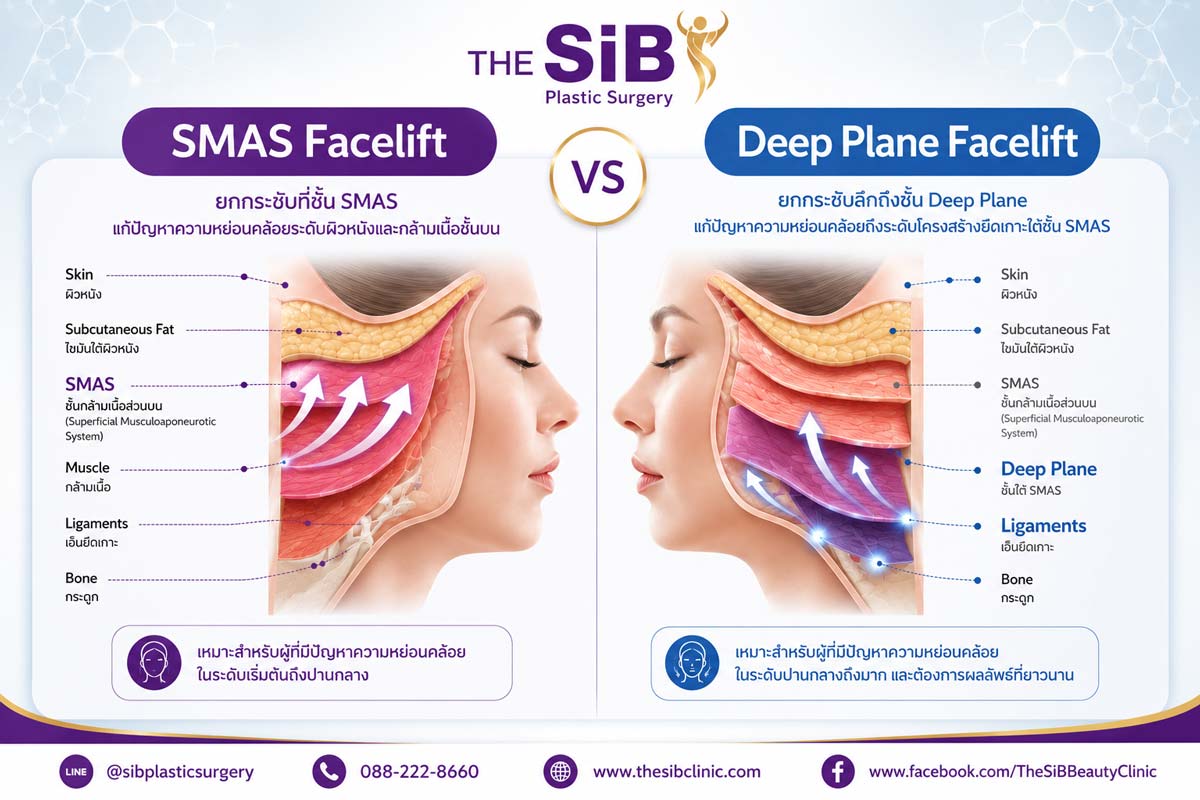
The main differences between a Deep Plane and an SMAS Facelift are the “depth” and the “management of facial retaining ligaments.” An SMAS Facelift tightens and sutures the superficial muscle layer (SMAS), which is suitable for those with moderate sagging. Meanwhile, a Deep Plane Facelift involves inserting tools deep beneath the SMAS layer to release the retaining ligaments. This allows for the lifting of the entire facial structure without tension. The result looks more natural, not tight or pulled, and decisively resolves deep nasolabial folds or heavily dropped jawlines with longer-lasting results.
Key Takeaways
- Who are these techniques for: SMAS is suitable for ages 35-50 with moderate sagging, while Deep Plane is ideal for ages 45 and up, or those with severe facial sagging, deep nasolabial folds, and undefined jawlines.
- Pros and Cons: SMAS requires less surgery time and results in less swelling/bruising. Deep Plane provides highly natural results and a deeper lift, despite taking longer in surgery.
- Recovery Time: On average, both take 1-2 weeks, but Deep Plane may cause a deep tightness sensation for slightly longer in the initial stages.
- Result Longevity: An SMAS Facelift lasts about 5-10 years, whereas a Deep Plane Facelift can last up to 10-15 years.
- What to know before deciding: The best technique is the one that suits your anatomical structure. You should always have a specialized doctor assess your skin tension and the direction of tissue descent first.

| Comparison Information | SMAS Facelift | Deep Plane Facelift |
|---|---|---|
| Suitable for | Moderate sagging (Age ~35-50) | Severe sagging, deep nasolabial folds (Age ~45+) |
| Depth Level | Above the SMAS muscle layer | Beneath the SMAS muscle layer |
| Facial Ligament Management | No ligament release | Ligament release |
| Duration | Approx. 3-4 hours | Approx. 4-6 hours |
| Recovery Days | 7-10 days | 10-14 days |
| Longevity | 5-10 years | 10-15 years |
| Advantages | Faster recovery, less swelling/bruising | More natural look, deeper lift, longer-lasting results |
Anatomical Differences
Our face is composed of multiple layers, from the skin, fat, and SMAS muscle down to the bone. The difference between these two techniques lies in “where the surgical tools are inserted.” An SMAS Facelift manages the shallower structures, while a Deep Plane Facelift penetrates through the SMAS layer down to the deepest structural spaces to unlock all facial anchor points.
- The SMAS Layer (Superficial Musculoaponeurotic System):
This is a sheet of fascia and muscle tissue covering the lower face and neck. Older facelift techniques only pulled the skin, but it was later discovered that pulling the SMAS as well yields better results. - Retaining Ligaments: These act like pillars anchoring the skin to the bone. As we age, these ligaments remain tightly attached, while the surrounding skin sags and drops, creating prominent nasolabial folds and marionette lines. To solve this at the root, these ligaments must be addressed.
What is an SMAS Facelift? Who is it for?
An SMAS Facelift (often called SMAS Plication/Imbrication) is a facelift technique that folds, sutures, or excises the SMAS muscle layer to tighten it, before pulling the upper skin smooth. This technique has long been a popular standard and provides excellent results for those whose problems are not yet deep-seated.
✅ Ideal Candidates
- Those with early to moderate sagging
- Those with beginning tissue descent around the neck and jawline, but nasolabial folds are not yet too deep
- Those who prefer a faster recovery
- Those with relatively thin facial tissue
Limitations: Because the retaining ligaments are not released, if a patient has very deep nasolabial folds, attempting to pull the SMAS tight enough to erase them might create excessive tension. This can result in a flat, stiff, or unnatural-looking face.
What is a Deep Plane Facelift? Who is it for?
A Deep Plane Facelift is an advanced technique where the surgeon dissects through the skin and SMAS layers down to the spaces beneath to “release” the retaining ligaments. Once the ligaments tethering the nasolabial folds are unlocked, the surgeon can freely lift the entire tissue block vertically without creating any tension on the skin itself.
🌟 Ideal Candidates
- Those aged 45 and above, or with severe sagging problems
- Those with distinct deep nasolabial folds and marionette lines
- Those with significant jowling around the jawline, obscuring facial contours
- Those who have had a previous facelift and require a revision (Revision Facelift)
- Those seeking long-lasting results of 10-15 years with maximum naturalness
Limitations: This is a complex surgery requiring a doctor with profound expertise in facial anatomy to avoid affecting facial nerves. Therefore, it comes at a higher cost and requires more operating time.
Comparative Summary: Which to Choose for the Best Value and Result?
Choosing between these two techniques is not about which is “the best,” but which is “most suitable for your specific concerns.” If you are younger and don’t have severe sagging, an SMAS Facelift is sufficient and cost-effective. However, if the sagging is deep, investing in a Deep Plane Facelift will be a better long-term solution.
- Choose SMAS Facelift: If you want clear results, prefer to save on surgery and recovery time, and your cheek descent and deep folds are not yet severe.
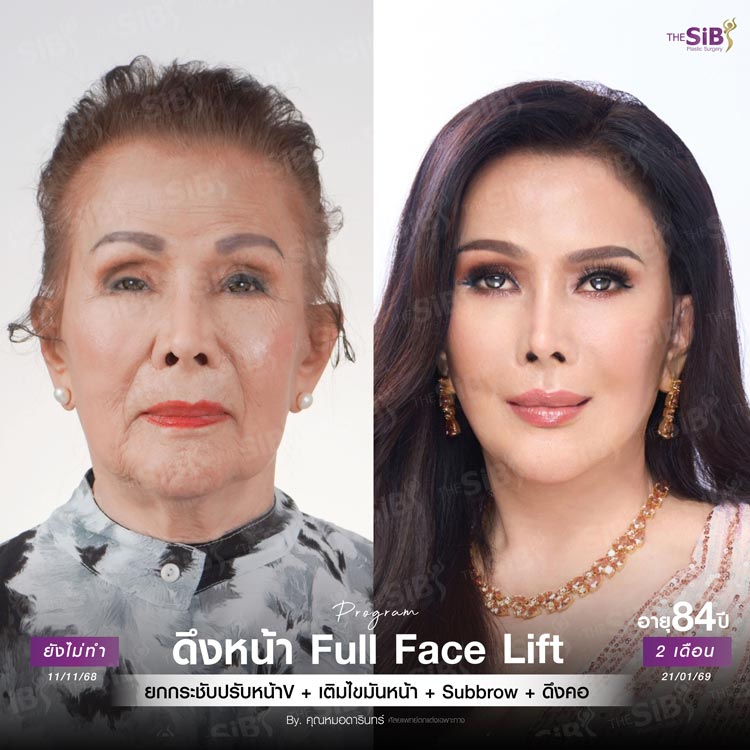
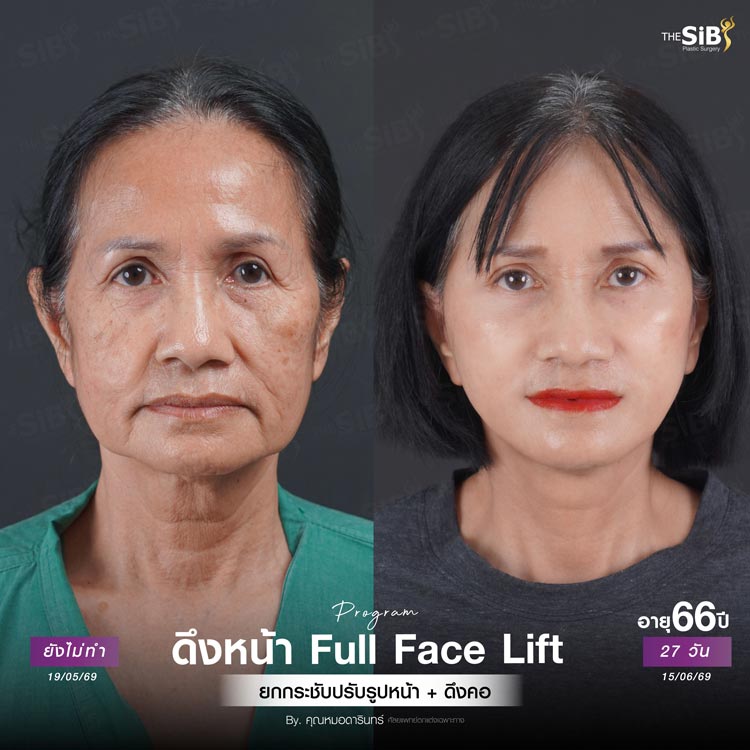
- Choose Deep Plane Facelift: If you want perfect rejuvenation, prioritize a natural look where the face doesn’t seem “pulled,” desire restored fullness in the midface akin to youth, and don’t mind a slightly longer recovery time.

Summary & Recommendation
Whether choosing the SMAS or Deep Plane technique, the most crucial factors are safety and the surgeon’s expertise. By choosing a facelift at The SiB Clinic with Dr. Darin Muangthai, you can be confident that you will receive a thorough, case-by-case facial structure assessment. The doctor will recommend the technique that yields the best return on investment (ROI) in terms of aesthetics, value, and longevity of results.
Our Recommendation for You: If you are still unsure which technique suits your level of sagging, we recommend taking front and side photos and sending them to The SiB Clinic’s medical team for an initial assessment. Alternatively, you can book a consultation with Dr. Darin Muangthai at the clinic to directly examine and analyze your skin thickness.

Frequently Asked Questions (FAQ)
If I’ve had thread lifts multiple times, can I still get a facelift?
Yes, you can. However, the doctor will first need to dissect and remove the scar tissue (fascia) caused by the thread lifts. The Deep Plane technique often addresses these types of revision cases exceptionally well.
Will the facelift scars look ugly?
Not at all. At The SiB Clinic, we use techniques to hide incisions along the hairline and in front of the ear. Combined with tension-free suturing, the scars will blend smoothly into the skin once fully healed.
If I regularly get filler injections for my nasolabial folds, should I switch to a facelift?
If filler injections start making your face look overly puffy (Overfilled Syndrome) and can no longer lift the sagging tissues, facelift surgery is a more direct and effective solution.
Which surgery is more painful during the procedure?
For both techniques, patients won’t feel any pain during the surgery because it is performed under general anesthesia administered by an anesthesiologist.
Can an SMAS Facelift be combined with double chin liposuction?
Yes, it can, and it’s very popular. Combining liposuction with an SMAS lift helps define the jawline and neck much more sharply.
Does a Deep Plane Facelift take months longer to recover from than an SMAS Facelift?
Not at all. Usually, a Deep Plane recovery only takes a few days to a week longer than SMAS (around 10-14 days), after which you can return to social activities.
Which technique is better suited for men?
Both techniques can be used, but men typically have thicker skin and muscle layers, along with heavier tissues. Therefore, a Deep Plane lift often provides a stronger, more effective lift for them.
How long will my face feel numb after the surgery?
Numbness on the facial skin and ears is normal after a facelift. It generally improves gradually and resolves on its own within 1-3 months.
Can I get a breast augmentation and a facelift on the same day?
They can be combined to recover from both at once, but the doctor must assess your physical readiness and ensure the duration of general anesthesia isn’t too long.


Considering cosmetic surgery in Thailand at The SiB Plastic Surgery?
Inquire or schedule a free consultation with our doctor.
 Whatsapp
  หน้าแรก
  โปรโมชั่น
  สอบถาม
  จองคิวฟรี