

 English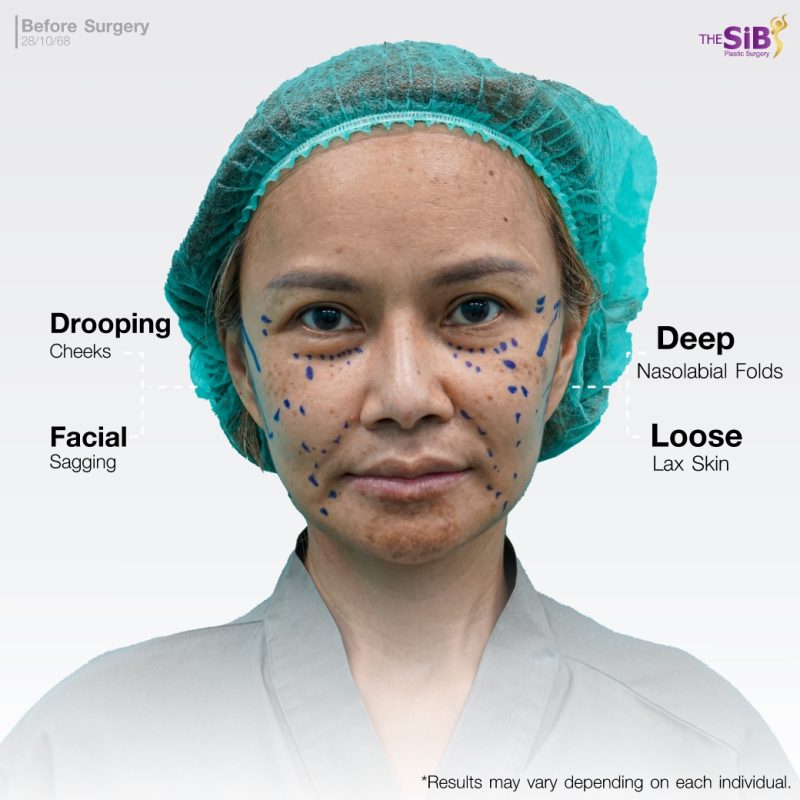
A Full Face Lift Revision Case That Proves
True rejuvenation comes from correcting the structure, not just tightening the skin.
For many patients, deciding to undergo a facelift is not an easy choice.
Especially for those who have already had a facelift once before, the hope is simple:
- “I want this to be the final solution.”
- “I want my face to look refreshed long-term.”
- “I don’t want to go through surgery again.”
Yet in reality, many patients return with the same concern:
The facelift didn’t truly solve the problem.
The face may appear tighter at first,
but over time, sagging returns.
The cheeks begin to droop again.
Nasolabial folds deepen.
The jawline loses definition.
And most importantly the face still looks tired.
This article presents a real Full Face Lift revision case,
demonstrating why tightening alone is never enough,
and why correcting the deep facial structure is the key to a result that truly lasts.
Why Facelifts Sometimes “Don’t Last”
A facelift is not simply about pulling the skin.
True facial aging occurs in the deep structural layer (SMAS) —
the foundation that supports the cheeks, jawline, and overall facial contour.
When the first facelift focuses mainly on skin tightening or insufficient SMAS repositioning, the result is often:
- Temporary tightness
- Early relapse of sagging
- A face that looks stretched, yet not truly lifted
- Or worse — a tight but unnatural appearance
Eventually, patients are left asking:
“Why does my face still look tired, even after surgery?”
Before Revision Identifying the Real Problem
In this case, the pre-revision images clearly revealed:
- Drooping cheeks causing a fatigued appearance
- Deep nasolabial folds indicating structural descent
- General facial laxity, not limited to one area
- Poor jawline definition
- An overall look of facial weakness and aging
These signs confirmed that the root cause was structural, not superficial.
Repeating a skin-only lift would never provide a lasting solution.
Why Revision Facelifts Are More Complex
A facelift revision is fundamentally different from a first-time procedure.
The surgeon must work with tissue that:
- Has already been operated on
- Has altered elasticity
- May have scar tissue and shifted anatomy
If the structural balance is misjudged, revision surgery can lead to:
- Over-tightening
- A stiff or “pulled” look
- Artificial facial expressions
This is why revision facelifts require advanced experience, not just standard techniques.
The Surgical Philosophy Behind This Full Face Lift Revision
At The SiB Plastic Surgery
the approach does not begin with the question
“Where should we pull more?”
Instead it begins with
“Which structural layers have lost balance and how should they be restored?”
This case was treated with a comprehensive Full Face Lift revision, focusing on:
- Deep SMAS repositioning
- Balanced lifting across the entire face
- Structural support rather than skin tension
- Preserving the patient’s original facial identity
The goal was never to create an “overly young” face
but to restore strength freshness and harmony naturally

Results at 14 Days: More Than Just Tightness
At just 14 days post-operation, the improvements were already evident:
- The face appeared lifted yet relaxed
- Cheeks returned to a natural, youthful position
- Nasolabial folds softened without forced tension
- The jawline became defined but not rigid
- Facial expression looked calm, rested, and natural
This is the hallmark of structural correction, not surface pulling.
Patient Experience: The Difference Patients Truly Feel
What impressed the patient most was not tightness — but comfort.
“My face doesn’t feel tight at all.
It feels light and relaxed.
When I look in the mirror, it still looks like me
just healthier and more refreshed.”
Even more telling were comments from others:
“You look brighter.”
“You don’t look tired anymore.”
“You look well-rested.”
Not:
“Did you have a facelift?”
Who Is This Revision Full Face Lift For?
This approach is ideal for patients who:
- Have already undergone a facelift
- Feel that the results did not last
- Still experience sagging cheeks or facial heaviness
- Want natural, long-term improvement
- Do not want a tight or artificial appearance
Why Surgeon Experience Matters in Revision Cases
Revision facelift surgery allows no room for error.
The surgeon must
- Accurately evaluate altered anatomy
- Understand deep facial structures intimately
- Control tension with precision
- Know exactly where not to pull
Because while anyone can make a face tighter,
only experienced hands can make it look naturally rejuvenated and long-lasting.
Conclusion: Why This Case Truly “Finished the Problem”
This Full Face Lift revision succeeded because it focused on:
- Structural correction
- Facial balance
- Long-term natural aesthetics
Not just immediate tightness.
If you have had a facelift before and feel that:
“Something still isn’t right”
the answer may not be more pulling,
but correcting the right layer from the beginning
A great facelift should look good
not only in photos
but in everyday life
Considering a Facelift Revision?
A proper revision facelift cannot be judged from photos alone.
It requires an in-depth structural evaluation by an experienced surgeon.
If you want to understand:
- Where your real problem lies
- Whether revision is necessary
- And how to achieve a result that truly lasts
This is the right place to begin


 LINE OFFICIAL
  หน้าแรก
  โปรโมชั่น
  สอบถาม
  จองคิวฟรี