

 English
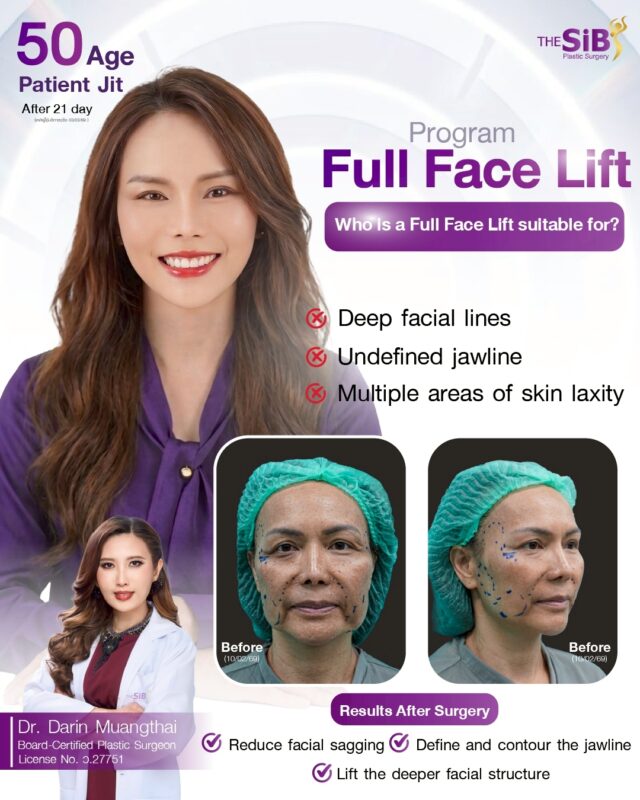
About 21 days after undergoing a Full Face Lift, this 50-year-old patient returned to the clinic for a follow-up appointment. This period is considered an important stage of recovery, as swelling gradually subsides and the newly lifted facial contours begin to settle into place.
At this stage, the improvements become much more visible. When comparing the after photos with the images taken before the procedure, the transformation can be clearly seen. The changes are not limited to one area of the face, but rather appear across multiple regions at once.
The cheeks look lifted again.
The jawline appears more defined.
Deep nasolabial folds look softer.
The lower face looks lighter and more balanced.
However, what many people may not realize is that these results are not simply achieved by tightening the skin.
The Concerns Before Surgery
Before the procedure, the patient had several common signs of facial aging that are often seen in people in their 40s and 50s, including:
- Sagging cheeks
• Deep nasolabial folds
• Loss of jawline definition
• Excess fullness around the lower face
• Under-eye laxity that made the face appear tired
These changes can make the entire face look heavier and more fatigued, even for people who take good care of their skin.
The main reason behind these changes is not just the skin itself. In fact, facial aging occurs because the deeper structural layers of the face gradually descend over time due to gravity.
As these deeper tissues move downward, the skin above them follows, creating folds, sagging, and loss of facial definition.
The Surgical Technique: Why the SMAS Layer Matters
The key element of this procedure lies in lifting the SMAS layer (Superficial Musculoaponeurotic System), which is the deeper structural layer of the face.
This layer supports the muscles and soft tissues of the face. As we age, the SMAS layer gradually loosens and shifts downward, leading to several visible signs of aging, such as:
- Drooping cheeks
• Deep facial folds
• Blurred jawline
• Heaviness in the lower face
Instead of simply pulling the skin tighter, the surgeon carefully repositions and lifts the SMAS layer, restoring the deeper foundation of the face.
Once the underlying structure is restored, the skin naturally redrapes over the lifted contour, creating smoother and more youthful facial lines.
This approach allows the results to appear natural and balanced, without the overly tight or artificial appearance sometimes associated with traditional skin-only facelifts
Restoring Balance to the Entire Face
A Full Face Lift is designed not just to address a single concern, but to restore harmony to the face as a whole.
For this patient, the surgical plan included multiple components to ensure balanced results:
- Facelift to reposition the mid and lower face
• Neck lift to redefine the jawline
• Fat grafting to restore lost facial volume
• Adjustment of certain facial muscles for improved contour
By addressing several elements of facial aging at once, the procedure helps restore the natural proportions of the face rather than focusing on one isolated area.
The goal is not to change the patient’s identity, but to recreate a younger, refreshed version of their natural appearance.
Visible Improvements After 21 Days
Around three weeks after surgery, the swelling continues to improve and the face begins to settle into its new contour.
At this stage, several improvements become noticeable:
- A sharper and more defined jawline
• Lifted cheeks that restore facial structure
• Softer nasolabial folds
• A smoother lower face without heaviness
• A brighter and more refreshed facial appearance
Most importantly, the face still looks natural and recognizable.
A successful facelift should not make someone look like a different person.
Instead, it should make them look like themselves—just younger, fresher, and more vibrant.
More Than Aesthetic Results Confidence Restore
For many patients, a facelift is not about transforming into someone new.
It is about restoring the facial structure to a state that reflects how they feel inside.
When the face appears refreshed and balanced again, confidence often returns as well.
And sometimes, that transformation begins to reveal itself in as little as a few weeks.



 LINE OFFICIAL
  หน้าแรก
  โปรโมชั่น
  สอบถาม
  จองคิวฟรี